
The EU AI Act is now enforcing: what boards and CFOs need to address today
August 19, 2026
Third-party risk management is not working
September 1, 2026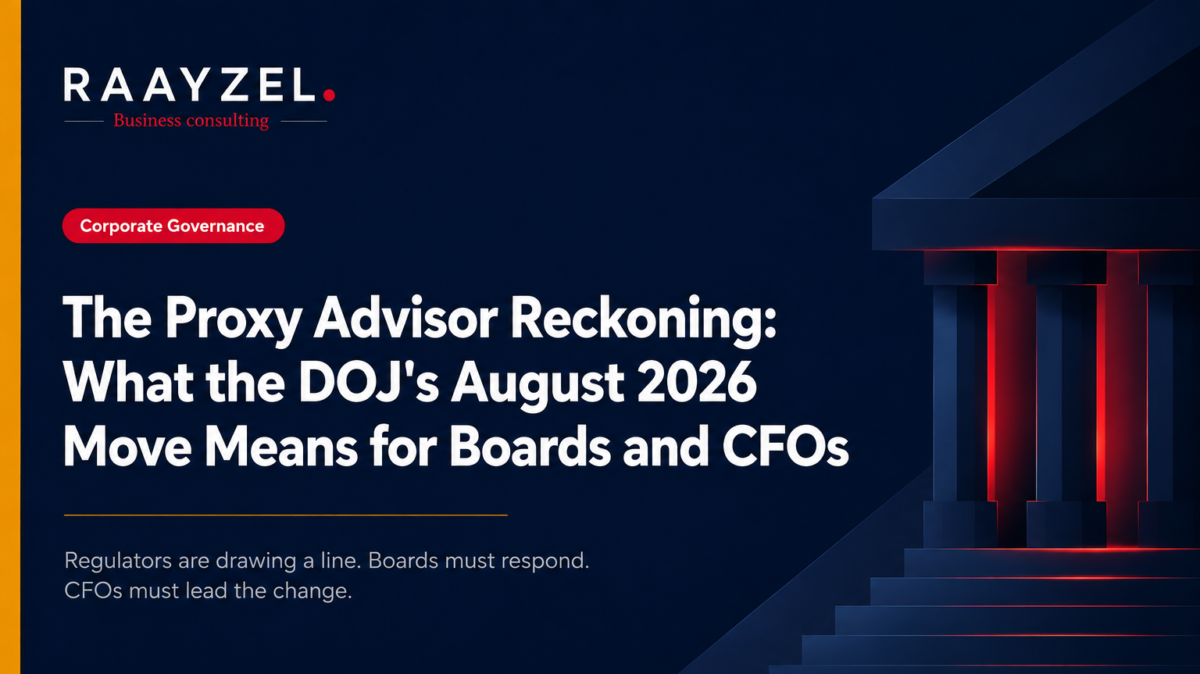
Corporate Governance / Regulatory Compliance | 6 min read | Raayzel Business Consulting
On 5 August 2026, the US Department of Justice Antitrust Division withdrew a business review letter it had issued to Institutional Shareholder Services in 1987, a letter that had given ISS effective antitrust protection for nearly four decades. The withdrawal is not an enforcement action and does not constitute a finding that ISS has violated antitrust law. But it signals something that boards, CFOs, and governance professionals need to understand clearly: the regulatory and legal environment around proxy advisory firms is changing in ways that will affect how institutional investors engage with corporate governance, and organisations that rely on proxy advisor recommendations to frame their governance strategy need to recalibrate.
This article examines what the DOJ’s action actually means, why it matters beyond the immediate US regulatory context, and what the governance implications are for boards and senior leaders at enterprise organisations.
What happened on 5 August 2026
The 1987 business review letter was issued when proxy advising was in its infancy. At that time, ISS represented that it would advise only on voting rights and corporate governance and would not engage in discussions about corporate operations or business activities. The DOJ issued the letter on that basis, indicating it had no current intention to challenge ISS’s establishment and operation under antitrust law.
In withdrawing the letter, the DOJ made two observations that are significant in their own right. First, ISS’s business has changed dramatically since 1987. ISS now provides consulting services to the same companies it produces voting recommendations on, creating a structural conflict of interest that the original letter explicitly excluded from its scope. Second, the market concentration of the proxy advisory industry has reached a level that the DOJ characterises as raising significant competition concerns. ISS and Glass Lewis together control more than 90 percent of the proxy advisory market. Their clients hold significant stakes in the largest publicly traded companies. The DOJ’s view is that this concentration gives ISS and Glass Lewis, in its words, tremendous influence over corporate governance matters at America’s largest companies.
The withdrawal came in the context of a wider regulatory and political environment that has been building pressure on proxy advisors for several years. A December 2025 executive order directed the SEC, FTC, and DOJ to examine whether ISS and Glass Lewis had violated rules or antitrust law related to their treatment of environmental and social issues. State attorneys general in Florida and Texas have brought separate legal actions against both firms. At least thirteen states have proposed or enacted legislation imposing disclosure requirements and other obligations on proxy advisory firms.
The conflict of interest at the centre of the debate
The structural problem that the DOJ’s withdrawal highlights is one that governance professionals have discussed for years but that has rarely been addressed directly by regulators. ISS operates two business lines that are in direct tension with each other. Its governance research division produces voting recommendations for institutional investor clients. Its consulting division advises the same companies on compensation structures, equity plan design, and board governance practices, effectively teaching them what they need to do to receive a favourable voting recommendation.
The DOJ’s withdrawal of the business review letter makes this conflict a matter of active regulatory interest rather than market commentary. For boards and governance committees, the implication is significant. If the proxy advisor recommendations that institutional investors have relied upon are themselves the subject of regulatory scrutiny, conflict of interest investigation, and potential enforcement action, the governance weight that boards have historically attached to those recommendations needs to be reconsidered.
Glass Lewis does not operate a consulting division, which the DOJ and market observers note reduces certain conflicts. However, both firms are subject to the market concentration concern that is the other pillar of the DOJ’s stated rationale for withdrawing the letter.
What this means for institutional investor behaviour
Proxy advisor recommendations have shaped institutional investor voting on executive compensation, board composition, shareholder proposals, and governance amendments for decades. Boards that have designed their governance practices around achieving favourable proxy advisor recommendations have effectively been designing around a standard that is now itself under question.
Two developments are running in parallel that compound this. First, effective from 2026, ISS announced it would no longer generally recommend voting for environmental and social shareholder proposals, instead evaluating such proposals on a case-by-case basis. This represents a significant departure from a policy that shaped institutional voting across thousands of companies. Second, several large asset managers have been expanding pass-through voting programmes that allow their underlying clients to direct voting rather than delegating to the fund manager, which in turn reduces the influence of proxy advisor recommendations on actual voting outcomes.
The combined effect is that the proxy advisory framework that has been a central reference point for corporate governance strategy is becoming more fragmented, more contested, and less predictable. Boards that have treated ISS and Glass Lewis recommendations as a reliable guide to what institutional investors want are entering a period where that assumption is less reliable than it has been.
The governance implications for boards and CFOs
The immediate practical implication for boards is not that proxy advisor recommendations can be ignored. ISS and Glass Lewis still control more than 90 percent of the market and their recommendations still influence voting outcomes at most public companies. The implication is that the governance rationale behind board decisions needs to be more independently grounded than a strategy designed primarily to achieve a favourable proxy recommendation.
For CFOs specifically, the compensation governance dimension is the most immediate area of exposure. Executive compensation structures that have been designed with proxy advisor methodologies as the primary reference point need to be assessed against a broader framework: what the company’s actual pay-for-performance relationship looks like, what the board’s remuneration committee can defend independently of proxy advisor guidance, and how the compensation disclosure narrative would hold up under direct institutional investor scrutiny rather than being mediated through a proxy advisor recommendation.
For governance committees and board chairs, the broader question is whether the organisation’s governance framework rests on its own coherent logic or on a set of practices that were adopted because they aligned with proxy advisor standards. In a regulatory environment where those standards are themselves under challenge, a governance architecture that cannot be defended on its own terms is a governance architecture that has a structural weakness.
The UK dimension
The DOJ’s action is a US regulatory development, but ISS and Glass Lewis operate globally. Both firms produce recommendations for UK listed companies, and their influence on UK institutional investor voting is material. The conflict of interest concerns and the market concentration concerns that the DOJ has raised are structurally identical in the UK context.
The UK Corporate Governance Code and the FCA’s stewardship expectations place significant weight on institutional investor engagement and voting as mechanisms of board accountability. If the proxy advisory infrastructure through which much of that voting is directed is subject to ongoing regulatory challenge in its home market, UK boards and governance advisors need to track how that challenge develops and what it implies for the governance expectations being applied through the UK stewardship framework.
Provision 29 of the UK Corporate Governance Code, which requires boards to provide a clear explanation when they cannot confirm compliance with the Code, already demands a higher standard of governance narrative than many boards currently maintain. In a period where the proxy advisory framework is under pressure, boards that can articulate their governance decisions with independent clarity rather than proxy advisor alignment are in a materially stronger position.
What boards should be doing now
The proxy advisor reckoning does not require immediate structural change for most boards. What it does require is a recalibration of the assumptions that have shaped governance strategy. Three areas warrant attention in the period immediately following the DOJ’s August 2026 action.
• Governance rationale review: Boards should assess which of their current governance practices were adopted primarily to achieve favourable proxy recommendations and whether those practices can be defended on their own merits. Practices that rest solely on proxy alignment rather than genuine governance logic are exposed if the proxy standard shifts.
• Compensation disclosure: Remuneration committees should ensure that the narrative supporting executive compensation decisions is grounded in the company’s own pay-for-performance analysis rather than structured around proxy advisor methodologies that are themselves under challenge.
• Institutional investor engagement: The fragmentation of proxy advisory influence and the growth of pass-through voting mean that direct engagement with significant institutional investors is becoming more important. Boards that have relied on proxy advisor mediation as a substitute for direct investor engagement are increasingly operating with an outdated model.
The governance question this development surfaces
The DOJ’s withdrawal of the 1987 business review letter is a US regulatory action. Its implications, however, touch something that is relevant to every board operating in a market where institutional investors are significant shareholders and where proxy advisors have shaped the standard against which governance is measured.
The underlying question the development surfaces is one that governance-mature boards should be able to answer clearly: does the organisation’s governance framework rest on its own coherent and defensible logic, or does it rest primarily on alignment with an external standard that was never fully subject to scrutiny? In a regulatory environment where that external standard is now being scrutinised directly, the difference between those two answers is the difference between a governance architecture that is durable and one that is contingent.
The proxy advisory system is not disappearing. But the certainty with which boards and governance advisors have treated its recommendations as the definitive reference point for institutional investor expectations is in the process of being revised. The organisations that use this moment to strengthen the independent foundations of their governance framework rather than simply waiting to see how the regulatory environment settles will be in the stronger position across the next period of governance evolution.
Raayzel works with boards, governance committees, and CFOs to assess governance framework effectiveness, strengthen the independent rationale behind governance decisions, and build the disclosure and engagement capabilities that the current governance environment requires. The work is advisory and execution-oriented, calibrated to the specific governance profile and investor base of each organisation.
Stay ahead of the corporate governance and regulatory compliance agenda.
Sign up for free insights and resources from Raayzel Business Consulting: https://lp.constantcontactpages.com/sl/sBV4psC/insights
Book a free 30-minute consultation with us at Raayzel: https://calendly.com/raayzelconsulting/30min